
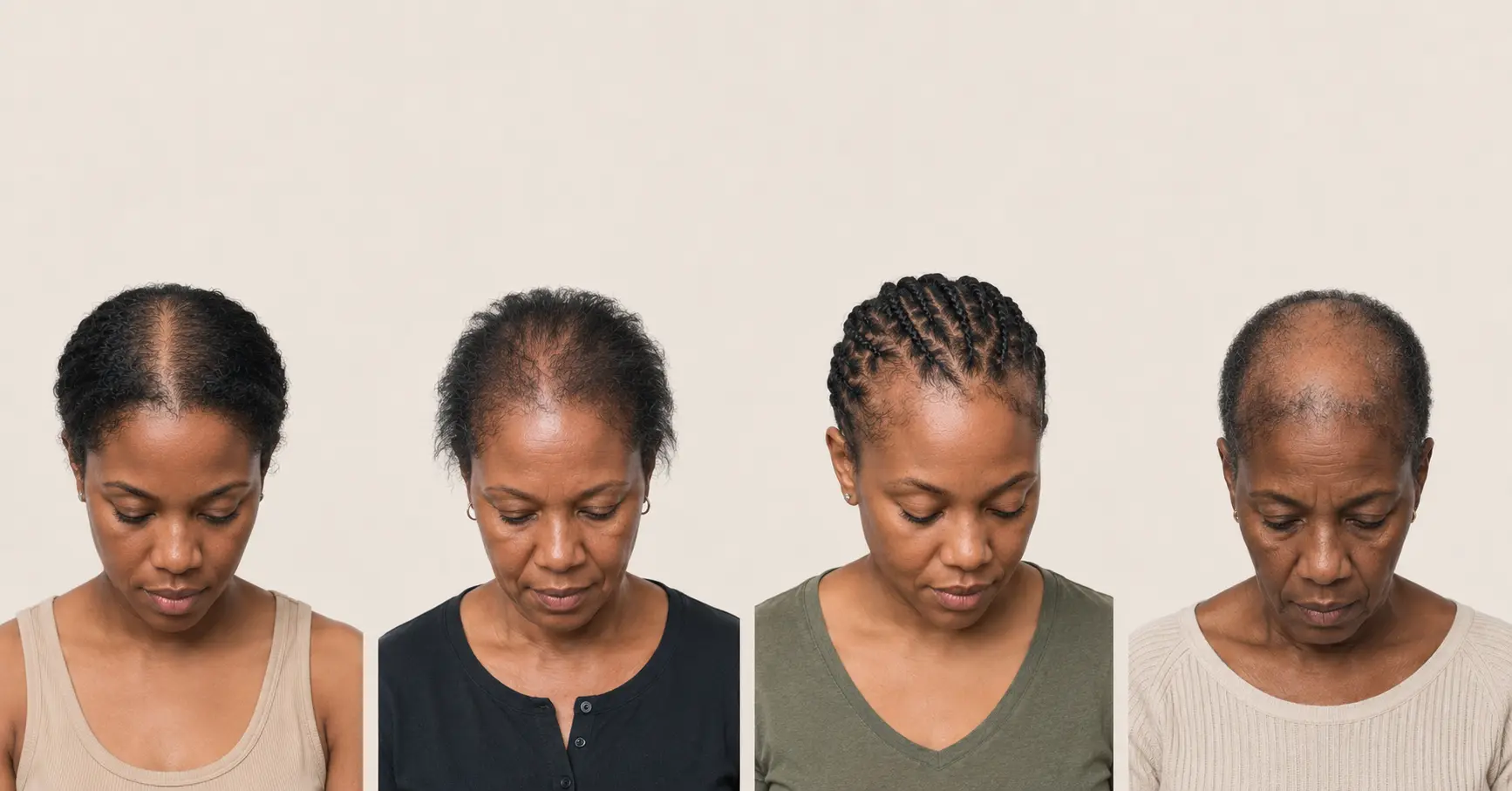
Female hair loss does not always look like a bald patch. It may appear as a widening part, reduced ponytail volume, thinning edges or a slowly changing hairline. The correct treatment depends on identifying the cause early.
Traction alopecia
Repeated tension from tight braids, cornrows, ponytails, extensions, wigs or weaves can weaken the hairline and temples. Early cases may recover after the tension stops. Long-standing smooth or scarred areas may need specialist evaluation for restoration.
Telogen effluvium
This is widespread shedding that can begin several weeks after childbirth, illness, surgery, severe stress, rapid weight change or nutritional deficiency. It is often temporary, but persistent shedding should be investigated rather than assumed to be normal.
Alopecia areata
Alopecia areata is an autoimmune condition that often causes sudden, smooth, round patches. Diagnosis and medical management come before cosmetic restoration. Transplantation is not usually considered while the condition is active.
Female pattern hair loss
This common condition usually causes gradual thinning across the crown and a widening central part. Options may include medical management, correction of contributing deficiencies, platelet-based treatments where appropriate, and transplantation for carefully selected candidates with a stable donor area.
Frontal fibrosing alopecia
A receding frontal hairline accompanied by eyebrow loss can indicate a scarring alopecia. Because permanent follicle damage can occur, early assessment by an appropriately qualified clinician is important.
Which treatment may help?
Female hair-loss care in Nairobi and Kampala
Turkish Hair Experts supports women seeking discreet hair-loss assessment in Kenya and Uganda. The first objective is not to sell a procedure. It is to determine the pattern of loss, identify whether referral or medical tests are needed, and explain realistic options.
Request a private assessment.
Send well-lit scalp photographs or arrange a consultation in Nairobi or Kampala.